



The Finnish Meteorological Institute (FMI) makes observations and research on the atmosphere, the near space and the seas. It also provides services on weather, sea, air quality, climate and near space for the needs of public safety, business life and citizens. FMI is an administrative branch of the Ministry of Transport and Communications.
Bringing strategic expertise to REALCHEM
FMI joined the REALCHEM consortium because the project addresses a scientifically and societally highly important topic: understanding the real-world emission characteristics and impacts of low‑carbon fuels in hard-to-electrify transport sectors.
The opportunity to provide FMI’s knowledge in atmospheric measurements, emission characterization, and air quality impacts to this international effort was therefore a natural and highly welcome one. REALCHEM also provides a valuable framework to continue and further develop the work initiated in the earlier EU project PAREMPI.
Building on this existing scientific foundation enables continuity, consistency, and long-term advancement in the study of emission factors and secondary aerosol formation from traffic-related sources. This continuity is particularly beneficial for addressing emerging pollutants associated with new fuels and technologies, and it supports FMI’s strategic goal of contributing robust, policy-relevant science to improve air quality and climate assessments over the long term.
In practice, what does this mean?
FMI contributes to the REALCHEM project by participating in experimental measurement activities, with a specific focus on detailed chemical characterization of emissions during the upcoming NRMM/HD measurement campaign in Autumn 2026. A special interest of FMI is the characterisation of chemical composition of secondary emissions from different transport sources, that can help in understanding the air quality and climate impacts of novel fuels and different transport sectors.
In addition, FMI is leading the task on the development of an emission factor database for emerging pollutants originating from different transport sectors. This database builds on the work initiated in PAREMPI project, which focused on emission factors related to secondary aerosol formation from various traffic sectors. Within REALCHEM, this work is expanded to cover a wider range of low-carbon fuels, technologies, and pollutants, thereby providing a solid scientific basis for air quality, climate impact, and exposure assessments in the future.
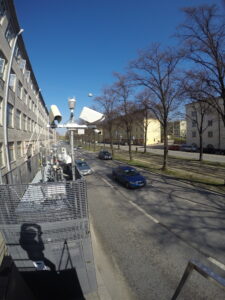
Helsinki traffic Supersite measurement station (©FMI)
For FMI, the importance of REALCHEM project relates to the provision of important information about the emissions of novel low-carbon fuels, and hard-to-electrify transport sectors emissions as well as their air quality and climate impacts now and in the future. The measurement and modelling results produced by the REALCHEM project are important for the research of the Finnish Meteorological Institute, as they help to improve emission inventories and can be used enhance the reliability of air quality and climate models. In addition, the results support national and European policymaking by enabling better assessment of the real environmental and health impacts of low-carbon solutions and hard-to-electrify transportation sectors.
If you want to know more about the Finnish Meteorological Institute, you check their website and LinkedIn page.