
Helmholtz-Zentrum hereon GmbH (Hereon) looks for solutions to achieve better air quality and finally improved human health, in particular in cities. Hereon investigates the relationship between pollutant emissions, atmospheric concentrations and human exposure with complex model systems on scales reaching from continents to urban streets. Transport in its various modes plays a major role in emissions of nitrogen oxides, volatile organic compounds and particulate matter.
The need for decarbonisation poses large challenges to the transport sector, especially when it comes to long-distance transport with ships, airplanes and also trucks. Most likely, these transport modes cannot be fully electrified, which means that they will rely on gaseous or liquid fuels, also in the future. However, it is still unclear which fuels will be used, and therefore, it is difficult to assess the potential effects of their use on air quality.
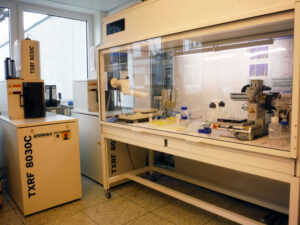
TXRF System and Clean Bench (Photo: Heike Helmholz/Hereon)
Selecting the best solution for the future of climate-neutral transport
REALCHEM gives Hereon the unique opportunity to get first-hand data on emissions from new fuels to be used in hard-to-electrify transport modes. This allows for the investigation of potential unwanted side effects before they enter the market in large quantities. By applying their model systems to calculate future air pollution in the case of the wide use of certain technologies, Hereon can give advice on the pros and cons of the solutions that are currently discussed to replace fossil fuels. Consequently, they can contribute to selecting the best solution for a future climate-neutral transport.
The leads in air pollution
Hereon leads REALCHEM’s work on air pollution and exposure projections. In this work package, we closely cooperate with colleagues from AUTh and IVL to construct current-day emission data that is calculated from transport activities and emission factors. This allows for considering classical as well as emerging pollutants in the emission data that will be further used in atmospheric chemistry transport models. Hereon also develop emission scenarios based on the available scientific literature and on expert knowledge coming from the REALCHEM stakeholder group. The scenarios will also include information from the technological trajectories and the life cycle assessment and they will consider future developments in other anthropogenic emission sectors. Finally, Hereon will provide quantitative information about the possible effects of certain future fuels and technologies on air pollution in Europe and in selected cities. These cities are Gothenburg, Hamburg, and Thessaloniki. They stand for differently sized cities with different contributions from aviation, shipping, heavy-duty road transport, and non-road mobile machinery. In addition, they represent different climate zones and therefore allow for a good estimate of the future air quality in European cities.
Why REALCHEM is relevant
REALCHEM will give science-based advice for a climate-friendly and least-polluting choice of future fuels in shipping, aviation, heavy-duty transport as well as machinery use in construction, agriculture, and forestry. Possible side effects of future fuels and exhaust gas treatment technologies will be investigated so that wrong pathways can be avoided and the most promising technology for decarbonising the hard-to-electrify transport sectors can be selected. The project combines the expertise of specialists in emission monitoring, chemical analysis, and chemistry transport modelling in a unique way. Experimentalists and modelers work closely together to find the best solution for using green fuels for long-range transport of goods and people. Giving a range of future emission scenarios and quantifying their impacts on air quality and human exposure allows for a well thought-through decision for future fuels, power-trains and exhaust-cleaning technologies.